

The Wild Louisiana Story of Acadiana’s Coozan Dud and His Snake Oil Hadacol
Known affectionately as "Coozan Dud," Louisiana businessman and politician Dudley J. LeBlanc became one of the most recognizable characters to ever come out of Vermilion Parish.
Not just a famous name around Acadiana, LeBlanc became famous around America for his miracle drug Hadacol, a vitamin tonic that promised to help with just about everything under the sun.
Call it snake oil, call it good ole Cajun ingenuity, but LeBlanc took his Hadacol miracle drug from his barn in Abbeville, to bottling it in Downtown Lafayette, to turning it into a nationwide sensation.
Exactly what was Hadacol and did it actually do anything?
Let's take a look into this Acadiana born cure-all elixir and the fascinating story behind it...
The Acadiana Politician Behind Hadacol
Dudley Joseph LeBlanc was born in 1894 and grew up in the Erath area of Vermilion Parish. Before his name became associated with his nationally famous tonic, LeBlanc was already making a name for himself as a businessman and politician in South Louisiana.
READ MORE: The Real Reason Cajun Last Names End in X
He had a personality that could fill a room and a talent for selling just about anything. Those skills eventually helped him build a successful political career, including four consecutive terms in the Louisiana State Senate.
But politics was only one part of Coozan Dud's story.
What Exactly Was Hadacol?
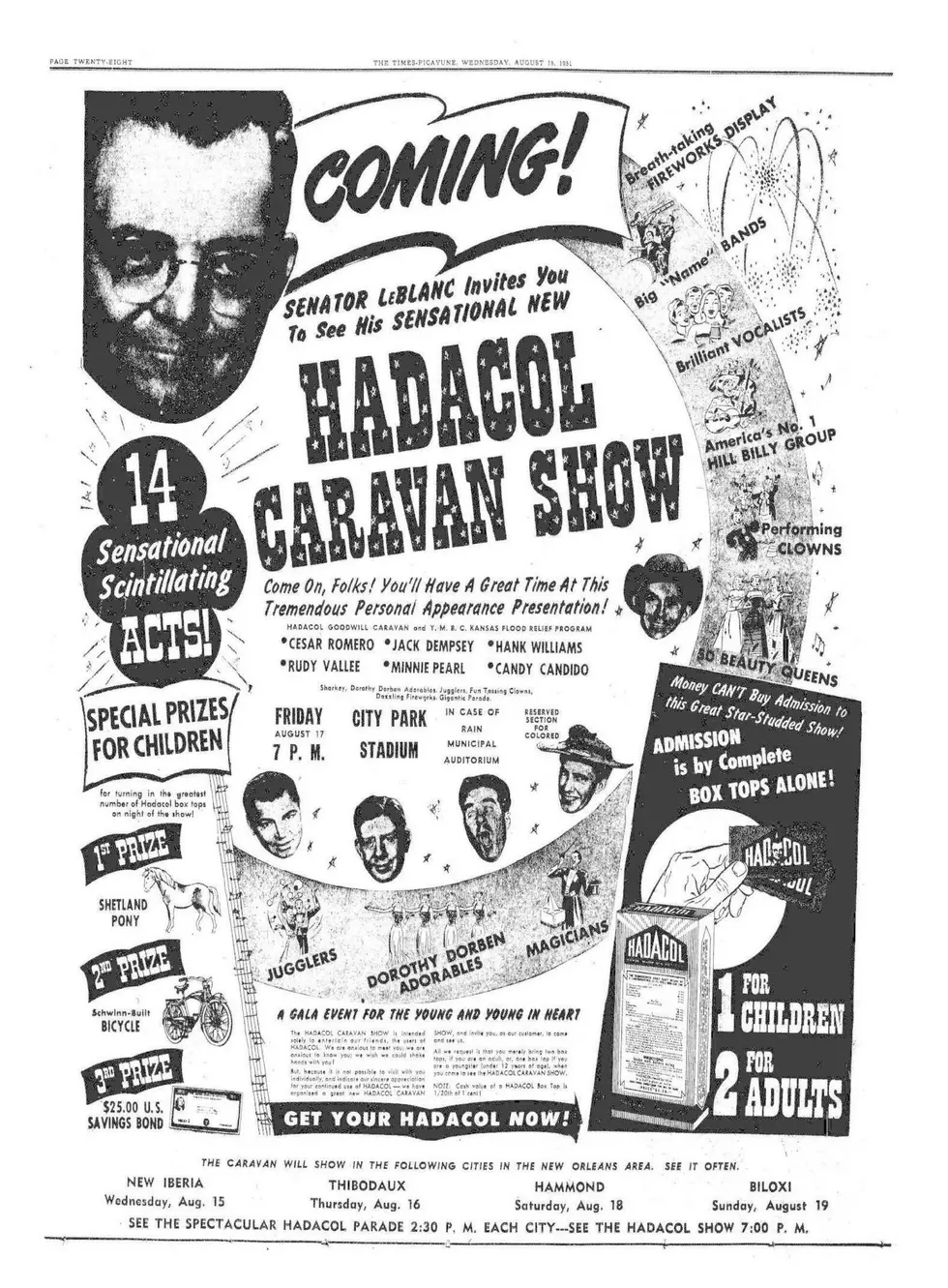
Depending on which advertisement or testimonial you came across, Hadacol was billed as a remedy for everything from arthritis and asthma to diabetes, epilepsy, heart conditions, and other serious illnesses.
From countryroadsmagazine.com "'Two months ago I couldn't read nor write. I took four bottles of Hadacol and now I'm teaching school.' —A 1949 radio testimonial for Louisiana’s famous cure-all medicine."
The above "testimonial" is obviously...well, insane, but it's advertising like that LeBlanc used all over America to promote his miracle tonic, Hadacol.
READ MORE: Louisiana's Most Cajun First Names Ever
According to jimramsburg.com, Hadacol contained B vitamins and "other ingredients", but one detail that helped make it especially popular was its alcohol content. Hadacol reportedly contained approximately 12% alcohol.
Hadacol reportedly sold for around $3.50 per bottle, which was no small expense for many families in the 1940s and 1950s. $3.50 then would be roughly $84.00 in today's money.
Hadacol Became a National Sensation
LeBlanc understood something that selling a product is one thing, but getting people talking about it is something else entirely.
He went all in on advertising Hadacol, using colorful promotions, testimonials, and a traveling promotional operation called The Hadacol Caravan where he traveled across the country selling his tonic. Basically, a traveling medicine show.
The caravan rolled into cities and towns with entertainers, musicians, comedians, and celebrities helping promote LeBlanc's tonic.
Some of the biggest names in American entertainment were associated with the traveling shows, including -
Hank Williams
Bob Hope
Lucille Ball
Mickey Rooney
Milton Berle
Hadacol eventually expanded into 22 states, and sales reportedly reached tens of millions of dollars. The business grew from a small Louisiana operation into a major national sensation.
According to a story published by 64 Parishes, Hadacol's business success was enormous, with reported sales reaching $25 million during a 15-month period ending in March 1951.
READ MORE: Things You Can Only Understand if You're From Louisiana
Hadacol also became the inspiration for a country tune called "The Hadacol Boogie."
The song was written by LeBlanc and first recorded in 1949 by Bill Nettles and His Dixie Blue Boys. It wasn't just some little promotional jingle, the song was a top 10 Country hit.
The Downfall of Hadacol
Unfortunately for Coozan Dud, the Hadacol success story didn't have a happy ending.
In 1951, LeBlanc sold the Hadacol business to the New York-based Tobey-Maltz Foundation, and the sale quickly became controversial. Reports at the time indicated that approximately $4 million in debt had not been disclosed to the new owners by LeBlanc.
The deal ultimately fell apart, and the company went into bankruptcy.
LeBlanc also faced scrutiny over his advertising practices. The Federal Trade Commission took aim at Hadacol's marketing claims, arguing that its promotions were deceptive.
After the downfall of Hadacol, Leblanc helped establish the Council for the Development of French in Louisiana, and published books about Acadian heritage and culture. LeBlanc worked to preserve and promote the French heritage of South Louisiana.
Was he a brilliant businessman? An unforgettable salesman? A controversial politician? Depending on which part of his life you're talking about, the answer could be all three.
For people in Lafayette, Abbeville, Erath, and throughout Acadiana, his story is another reminder that some of the most fascinating characters in American history came from right here in South Louisiana.
10 Times Cajuns Have Invaded Pop Culture
Gallery Credit: Michael Dot Scott